People: Turlough O’Carolan
1670 - 1738
An extraordinary Irishman, masterful harpist and composer of lyrical and poetic melodies
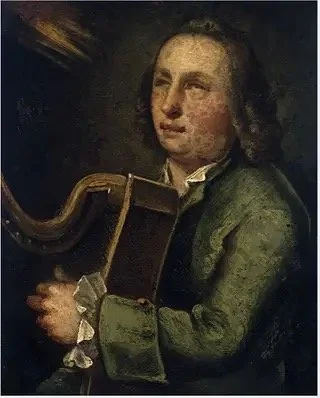

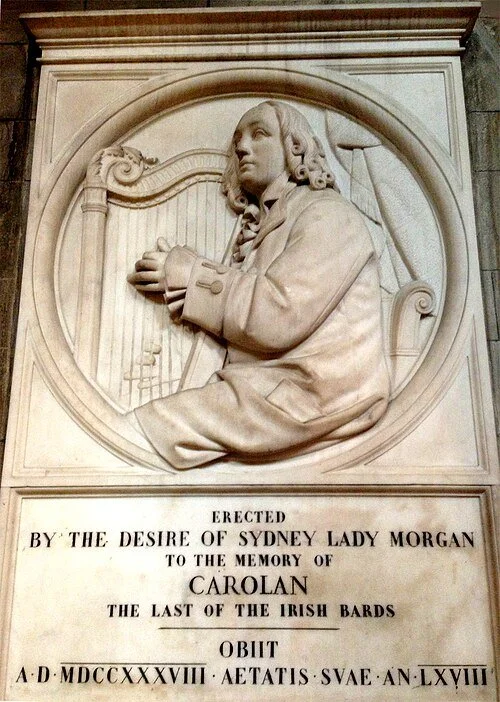
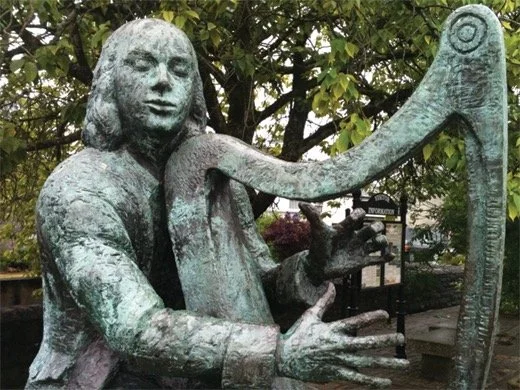
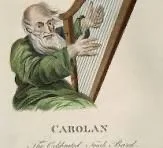
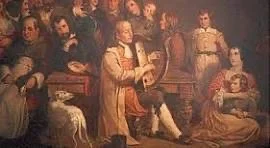
Turlough O’Carolan, blinded by smallpox at the age of 18, was driven by his love of playing the harp, composing music and creating poetry in the Irish tradition. Three hundred years later he is still and forever the echo of Ireland’s soul.
The early years…
It is thought that Turlough O’Carolan was born near the village of Nobber, County Mead, Ireland, born into a modest working class family. His father, John O’Carolan, worked as a small farmer and blacksmith until he had the fortunate opportunity to work for the MacDermots Roe of Alderford House in County Roscommon. The MacDermots Roe were a wealthy Galic noble family and steadfast supporters of the Irish arts and culture. So this move was an important turning point in young Turlough’s life, as the MacDermots Roe noticed that young Turlough was somewhat different from the other children. They sensed that he was a gifted, creative and intelligent child, and because of this provided him with a classic education alongside their own children. This is notable, as during this period in Ireland it was extremely rare for someone coming from Turlough’s background to receive an education such as this, and for that matter any education outside of the family home. In reality there was little to no education provided in the homes of the Irish working class at this time, and in most cases the parents did not know how to read or write.
Next…
Turlough suffered a tragic event that forever changed the direction of his life. At the age of 18 he contracted smallpox which left him totally blind. This unfortunate outcome marked the beginning of a new path forward that was to shape the rest of his life. In Ireland during this time it was common practice for blind individuals with promising artistic talent to be trained as harpists as a way to independence and a respectable, sustainable career. The MacDermotts Roe subsidized and arranged for Turlough to become a harpist under the tutelage of a local harp master and a mere two years later at the age of 20 Turlough wrote his first song for the harp called “Sí Bheag, Sí Mhór”. Translated from the Irish Gaelic to English it becomes, “Big Fairy, Little Fairy”. It describes the battle between two Fairy tribes, the queens of the Big Fairy Hill (Sí Mhór) and the queens of Little Fairy Hill (Sí Bheag). Here is a link to this Si Bheag, Si Mhór originally composed for the harp being played on a violin. https://www.youtube.com/watch?v=4sd_kWBiP-8
Three years after losing his site at the age of ~21, Turlough was ready to launch his career as a traveling harper, composer and story teller. Gifted with a personal guide and a horse due to the on-going support and generosity of the MacDermots Roe, Turlough began his musical Gulliver’s travels. His guide would lead the horse and help with all the needed logistics, such as helping him to find his way to maneuver unfamiliar surroundings. Thus, Turlough begins traveling across Ireland playing the harp, composing poetry/music and story telling.
He performed for wealthy patrons who supported his music as he traveled the Irish countryside far and wide. He gradually became well known, not only for his original compositions, beautiful melodies and accomplished harping, but also for his sharp wit and story telling. There are stories of him composing satirically biting verses for those people who insulted him and/or refused him hospitality. There are many historical recountings of his infectious charm, and reputation as a good conversationalist and story teller. All of these traits helped him build bridges and loyalty amongst his generous patrons across Ireland who provided him a sustainable living doing what he loved for over 50 years.
His later years…
At the approximate age of 50 Turlough married Mary Maguire of County Fermanagh and they went on to have a family of seven children, six daughters and one son. They settled down to family life in a cottage near Mohill, in County Leitrim. Turlough continued his work as a traveling harper criss-crossing Ireland, entertaining and story telling, which often kept him far from home. Unfortunately Mary died ~10 years later. After Mary’s death Turlough declined steadily, both emotionally and physically, continuing to work until his death five years later. He was buried in the MacDermott Roe family crypt at Kilronan Abbey, in County Roscommon.
Turlough remains one of Ireland’s most beloved and renowned harpists and composers. He was a masterful harpist, with a musical genius demonstrated throughout his compositions and melodies. Now some ~300 years later, 220 of his tunes survive and are are still played widely making him one of the most enduring and prolific figures of the Irish harp tradition. He remains today a deeply beloved and poetic Irish figure.
When I began to play the violin one of the first songs presented to me that I was eventually able to play in its entirety, was O’Carolan’s “Sí Bheag, Sí Mhór”. From that moment on I was drawn to his hauntingly beautiful melodies. I am so thankful for the gift of music he left behind.